

Party Wall etc. Act 1996 specialists
Party Wall Surveyors in London
As renowned party wall specialists in London, we have been trusted for over 20 years to deliver projects and protect people's homes.
Which describes you?
- RICS regulatedExperienced team of RICS surveyors
- FPWS & P&T membersMembers of the relevant governing bodies
 4.8 on GoogleFrom over 800 reviews
- Impartial adviceStraightforward, honest and professional
For building owners
Planning an extension, loft conversion or basement?
If you are planning a kitchen extension, converting the loft space, reconfiguring internal layouts or excavating a basement, the proposed works may well fall under the Party Wall etc. Act 1996.
Where work falls within the scope of the Act, you must serve notice and obtain your neighbour's (the adjoining owner's) consent. Notice periods are 1 month for new walls at the boundary and adjacent excavation, and 2 months for work to a party structure. Due to the complexity of the process, notices are normally served by an appointed surveyor.
For adjoining owners
Received a party wall notice?
You should respond within 14 days of receiving a notice. After that you are deemed to have dissented and must appoint a surveyor.
The Act confirms that adjoining owners must not suffer unnecessary inconvenience as a result of the works, and must be compensated for any loss or damage suffered.
Your time to respondCounted from when you receive the notice.
Your three options
- 1Option 1
Consent
No surveyor involvement
Work can proceed once the notice period has run or been waived. Consent can be conditional, for example on the building owner paying for a schedule of condition.
- 2Option 2
Dissent and agree a single surveyor
One surveyor for both owners
One 'agreed surveyor' acts for both owners and resolves the dispute impartially.
Recommended where work is relatively straightforward.
- 3Option 3
Dissent and appoint your own surveyor
A surveyor for each owner
Each owner's surveyor works together to resolve disputes.
Usually preferred on complex projects such as basements and large-scale works.
The law, in plain English
What is the Party Wall Act?
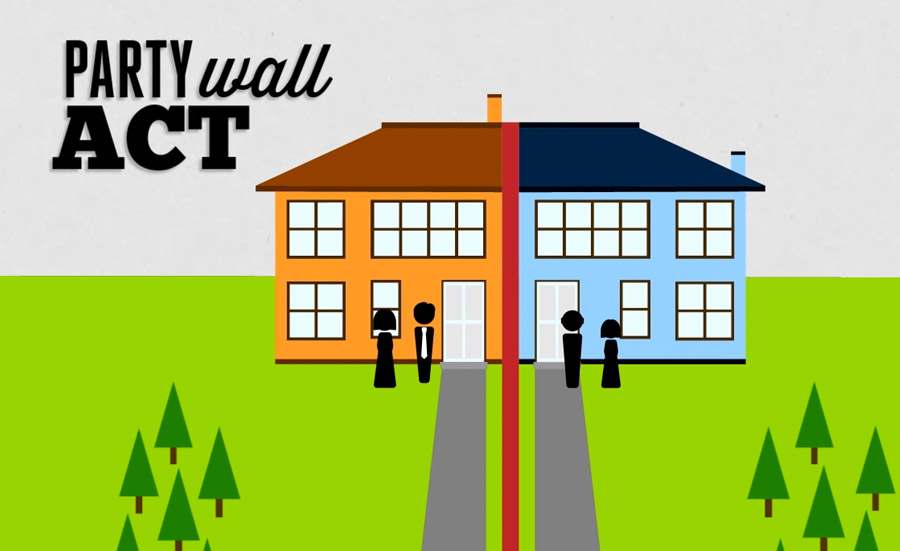
The Party Wall Act is an important piece of legislation in England and Wales. It is designed to facilitate development while protecting adjoining properties from damage, and their occupants from unnecessary inconvenience.
The Act provides a clear legal framework for resolving any disputes that may arise in relation to party walls and other party structures. It also gives the owner undertaking the work (the building owner) certain rights, such as a right of access to neighbouring land where that is necessary to carry out the notified works.
What the Act covers
Types of work covered by the Party Wall Act
Notifiable work falls into three categories, each corresponding to a different section of the Act.
 Section 1
New boundary walls
Building a new wall up to, or astride, the boundary line.
Read the detailHide the detail
The most common type of new building covered by the Act is the construction of a wall up to (but not beyond) the boundary, technically referred to as a '1(5) wall'. Adjoining owners can incorrectly believe that new walls must be set slightly back from the boundary, but that's not the case. As long as all elements of the extension, including the roof verge, gutters and fascias, do not project, the wall can be built right up to the boundary and does not require the adjoining owner's consent.
A new wall built equally astride the boundary, a '1(2) wall', is less common, as it does require the adjoining owner's express consent. Building astride the boundary can benefit both owners: the building owner gets a larger extension, and the adjoining owner keeps a right to use the new wall in the future should they build their own extension (subject to paying an enclosure cost).
 Section 2
Work to a party structure
Cutting into, raising, underpinning or rebuilding a shared wall.
Read the detailHide the detail
Section 2(2) of the Act lists various rights owners have in relation to existing party structures (both party walls and party fence walls). The most common are:
- 2(2)(a)
- To underpin a party wall, typically when extending into a basement but also where necessary to strengthen its foundations. This also covers raising a party wall, such as at main roof level for a loft extension.
- 2(2)(b)
- To repair, or demolish and rebuild, a party structure, most commonly a garden wall, as a result of damage or wear and tear.
- 2(2)(f)
- To cut into a party wall so that steel beams, joist hangers or a lead flashing can be inserted, for example for a loft conversion or the removal of a structural wall.
- 2(2)(g)
- To cut something away from a party wall, such as a chimney breast or internal wall.
- 2(2)(l)
- To raise, or demolish and rebuild, a party fence wall, for example as part of a rear extension.
- 2(2)(n)
- To expose a party wall, either temporarily during building works or permanently when part of a building is demolished (subject to providing adequate weathering).
 Section 6
Adjacent excavation
Digging foundations within 3 metres of a neighbouring building, deeper than its foundations.
Read the detailHide the detail
This section applies where foundations are to be excavated within 3.00m of a neighbouring property, including any shared walls, and to a greater depth than the base of that property's foundations. Most London housing stock is Victorian or 1930s, and foundations of that age rarely exceed 600mm in depth. Modern mass concrete foundations typically start at a depth of 1.00m to satisfy Building Control, and can be much deeper. This section may also apply to shallower pad foundations, or where entire sections of land are lowered.
Step by step
The party wall procedure
From first notice to final inspection, here's what happens.
- 1
Service of notices
Building owners must notify all affected adjoining owners of proposed work under sections 1, 2 and 6 of the Act. This is normally done by an appointed surveyor, though some homeowners choose to serve notice themselves. Notice periods are 1 month for sections 1 and 6, and 2 months for section 2.
- 2
Response
The adjoining owner should respond within 14 days. They can consent, agree a single surveyor, or appoint their own surveyor (see the three options above).
- 3
Schedule of condition
A record of the condition of the adjoining owner's property, in images with commentary, prepared before work starts. It can be referred back to if damage is reported during or after the works.
- 4
Agreeing the party wall award
The award (often incorrectly called a party wall agreement) resolves the dispute that arose when consent was not given. It sets out the time and manner in which the work is done. For example, the surveyors may require cutting into the party wall for steel beams to be done with hand tools only, or excavations close to the neighbouring property to be dug in 1.00m sections.
- 5
Service
Once the award and any drawings are finalised, it is served on both owners. The building owner can then legally start work, once any notice periods have passed or been waived.
- 6
Final inspection
Where works are high risk, the award may allow the adjoining owner's surveyor to inspect again at the end of the works. If damage has occurred, the adjoining owner can let the building owner's contractor make good, or receive a payment in lieu and use their own contractor.

Planning works? Send us your plans
Receive free, no obligation advice specific to your property, and a competitive quote.


 Google reviewParty wall
Excellent ‘old-fashioned’, impressive and highly diligent professional service concerning a Party Wall Award and much more (re Security Expenses, the Escrow Agreement, etc.), delivered with precision and attention to detail, and aided by modern technology, from Matthew Price, the surveyor, and Trina Shoat, the administrative support- WELL DONE & thank you…!
N Kot

Handled byMatthew Price, Associate Director
- Google reviewParty wall
I appointed Peter Barry Chartered Surveyors (PBCS) to act in connection with a Party Wall Notice that I received from my neighbour. Callum Escott of PBCS has dealt with the matter in a most professional way and kept me updated throughout even when delays occurred due entirely to the surveyors acting for my neighbour. I have absolutely no hesitation in confirming 100% satisfaction with PBCS.
Alfred Burgess

Handled byCallum Escott, Residential Surveyor
- Google reviewParty wall
I appointed Peter Barry as the agreed party wall surveyor for myself and my two neighbours. I had a great experience, my surveyor Katie Merchant was friendly, efficient and very thorough. I now feel very confident moving forwards with the two party wall awards in place. Thanks so much Katie, Trina and team!
Cate Fisher

Handled byKatie Merchant, Residential Surveyor
- Google reviewParty wall
Highly recommended. Very responsive to emails, great communication and very knowledgeable. Really cannot fault them and would most definitely use again and recommend to friends and family. I was totally clueless about what was involved in a party wall negotiation situation and they took the time to explain what was involved and how they would navigate the situation on my behalf. It took the stress away and reassured me completely.
Gemma Slade
- Google reviewParty wall
We were very happy that Peter Barry contacted us about the party wall issue with our neighbour's planning application. They helped us draw up a Party Wall Agreement, which wouldn't have happened otherwise. The service they offer is invaluable for protecting one's own property and rights from the effects of an adjoining neighbour's extension plans. We have recourse if there is damage to our property as a result of neighbouring works. Would recommend engaging their services.
R M
- Google reviewParty wall
Maianh dealt with our request for a Party Wall Agreement Award quickly and efficiently.
Sue Bickford

Handled byMaianh Nguyen, Assistant Surveyor
- Google reviewParty wall
Peter Barry were proactive in alerting me to the need for a Party Wall agreement. They were easy to deal with and the office team worked hard to coordinate meetings.
Cinders47
- Google reviewParty wall
Professional and responsive in handling a Party Wall matter.
Keith
Your party wall team
Meet your party wall surveyors
At Peter Barry, we have a dedicated team of experienced RICS party wall surveyors, assistant surveyors and specialist party wall administrators to make sure everything runs smoothly.
Meet the whole team






Why Peter Barry
Why choose Peter Barry?

Party wall specialists
Leading London-based party wall specialists, part of a firm established in 1983.

RICS surveyors
Breadth and depth of expertise from an experienced team of RICS surveyors.

Professional team
Straightforward, honest, impartial professional advice.

Best practice
Up-to-date understanding of best practice and case law through training and CPD.

Governing bodies
Members of relevant governing bodies: RICS, FPWS and P&T.
FAQs
Party wall FAQs
My neighbour is building but hasn't informed me about any work taking place. What can I do?
Before undertaking any major renovations or construction that affects a party wall or adjoining structure, an owner must seek consent from affected neighbours. If they do not, they are acting unlawfully and you may have to apply for an injunction to stop them. We would always recommend that you take legal advice and attempt to discuss the matter with your neighbour before going down this route.
I have just found out that I need to serve notice on an adjoining owner but my construction has already started. Should I stop?
Yes. If you have not gained consent from any affected adjoining owners, or been through the Act's dispute resolution procedure, your work is being conducted unlawfully and should be paused (making sure all structures are stable). The works should not continue until you have served notices to cover the remaining work and followed the necessary procedures under the Act. Any disputes that arise must be dealt with by surveyors appointed under section 10 of the Party Wall Act.
When does the Party Wall Act apply?
The Act covers three types of work: building along the boundary between two properties, excavating within prescribed distances of shared or adjoining structures, and altering a party structure. Notifiable works include cutting into the walls dividing terraced houses to insert beams as part of a loft conversion, excavating within 3.00m of a neighbour's property to build the foundations of an extension, and building the flank wall of an extension at the boundary.
Is there anything I can do about the construction noise coming from next door?
As an adjoining owner or occupier, you are expected to tolerate "reasonable disturbance". However, your neighbour also has a responsibility to carry out their alterations without causing unnecessary inconvenience. If you suffer a quantifiable loss as a result of works covered by the Party Wall Act, you will be eligible for compensation (for example, if you run a business and customers can no longer use your premises). Your neighbour must still follow normal health and safety legislation and environmental protection laws, such as keeping noise and vibration within local limits and working within time restrictions.
Do I have to allow my neighbour's contractors on to my property?
The Party Wall Act does require you to give your neighbour access to your land if their construction work cannot be completed any other way and they give you the required notice. This is normally 14 days, but if an urgent matter occurs (such as a burst pipe), the notice can be reduced in proportion to the emergency. Access must be 'necessary', so if there is an alternative way for your neighbour to do the works, even if it is slightly more expensive, that's what they should do.
Why should I appoint a surveyor?
Appointed surveyors prepare a schedule of condition covering the 'at risk' parts of the adjoining property before any construction begins, and this is strongly recommended. If damage occurs as a result of the work, the schedule of condition protects both parties from unfair or misleading claims, because it proves the property's condition before work started. Surveyors also prepare a party wall award to regulate the time and manner of the works, covering important points such as working hours, access and safeguards to reduce the risk of damage.
Can building work start before the award is finalised?
No, or at least not the part of the works covered by the Act. While it can be tempting to start before the award has been agreed and served, doing so would be unlawful.
What do I do if I'm struggling to recoup costs from my neighbour?
If an adjoining property is damaged as a result of works covered by the Act, the owner can either allow the building owner's contractor to make good or request a payment in lieu. Any disputes over the cause of the damage or the cost of making good can be referred to the appointed surveyors, whose decision is confirmed in a further award. The award will include a timescale for the payment in lieu. If a payment confirmed in an award is not made, the parties can take enforcement action in the Magistrates' Court.
Areas we cover
Party wall surveyors across London
We cover the whole of the inner M25 area from our network of London offices, so whether you're planning work that falls within the scope of the Act or you've received a notice, you're very welcome to contact us for advice.
London offices

Free quote
Request a party wall quote
Get a fast, free, no obligation quote today.
- Free quote
- No obligation
- RICS regulated
 Google review
Maianh dealt with our request for a Party Wall Agreement Award quickly and efficiently.

Or email your plans to surveying@peterbarry.co.uk
Insights
Related posts
Party walls
Flats and the Party Wall Act: More Work Affecting Party Structures
In the previous post, I looked at which owners should be notified of works directly affecting a party structure (under section 2) when the adjoining property is divided into flats.
Party walls
Flats and the Party Wall Act: Work Affecting Party Structures
Once a building owner has established the layout and demise of the flats within an adjoining building, the next step is to work out how they are affected by the proposed works.
Party walls
Flats and the Party Wall Act: Who is an ‘Owner’?
Section 20 of the Act defines an owner, amongst other things, as ‘a person in possession of land, otherwise than as a mortgagee or as a tenant from year to year or for a lesser term or as a tenant at will’.